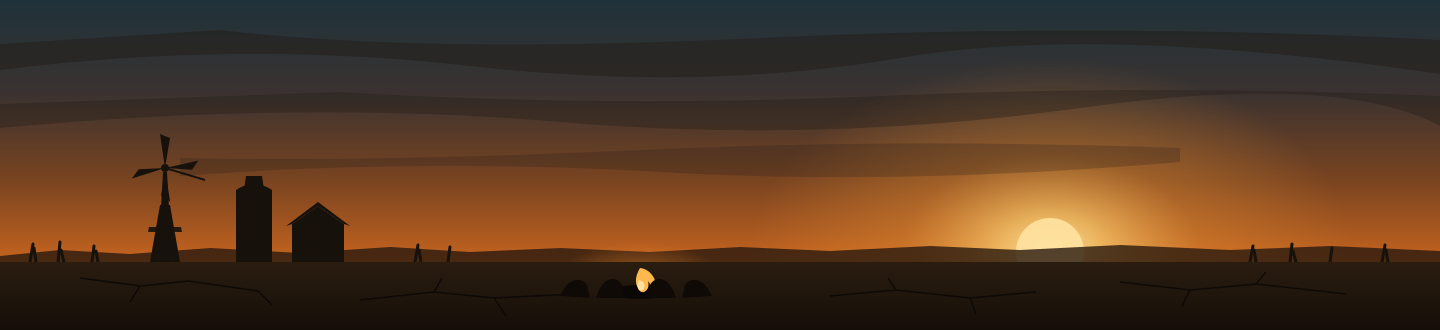
The Reyes combine died on a Thursday, and Dad was forty miles away at a compact hearing, and that is how the valley found out about me.
Mrs. Reyes came up our drive at a speed that told the whole story before she did, gravel announcing her from the county road on. Their machine (a mid-'20s brand that died in the second wave of company funerals, orphaned before Theo could walk) had quit in the shed during its pre-season checks. Screen black. No error code, no click, no courtesy. Their oat contract had a date on it, the custom cutter they'd have to hire instead had a waiting list and a price, and Dad had a signal dead zone and a hearing docket until dark.
"I can look," I said.
I heard myself say it the way you hear a rock leave your hand: already gone, nothing to do now but watch where it lands. Mrs. Reyes looked at me, seventeen years old with bean strings on my shirt, and then past me at the porch, where Grandmother sat snapping beans and did not look up, did not slow down, did not say one word, which, if you know her, is a notarized letter of reference. Mrs. Reyes said, "Get your things."
My things. The tablet with Dad's toolchain on it. The headlamp. And the green cable: second of its daughters, the one Dad crimped for my fifteenth birthday, which at the time I thought was a strange gift and now understand was a diploma, issued in advance, the way this family does everything: before you're ready, so that you will be.
The drive over took six minutes and I rehearsed the liturgy for all of them, lips moving like Dad over a log. Isolate. Panel. Pins. Log. Read till it stops being weather. Mrs. Reyes, mercifully, talked the whole way (the oats, the contract, her sister in the Lakes country) and required nothing of me but the occasional vowel, which I now believe was deliberate, and kind.
The talk had freight in it, though, and I kept some. The oats were going to a Lakes elevator, half in credits, the good half already spoken for against the seed bill; the custom cutter, when she had called him that morning, had named a figure she repeated to me to the decimal and then translated, in case I'd missed it, into what it actually was: the year's margin, riding away in a stranger's cab. Then her sister, the one in the Lakes town: visits when the paperwork allows, letters when it doesn't, and the oat money was half of that visit too.
And the combine. She talked about the machine the way you brief a doctor on a parent. It came with the farm, older than their deed to it. It had cut every acre they had ever contracted. It had never once quit on them in a field; she wanted that understood before I touched it. Never once, in a field. It quit in the shed, on the checks, not halfway down anybody's rows. Considerate, for an orphan.
The Reyes shed smelled like oat dust and bar oil and forty years of patched things, and the combine sat in the middle of it with the specific silence of a machine that believes its world has ended. They're different, the silences. A machine that's merely off is furniture. An orphan that's given up has a presence, like a horse that won't come to the rail. You feel watched by the thing you're trying to save. Dad says that's projection. Dad also talks to tractors, so.
I pulled the side panel the way I'd watched a hundred times and had done exactly four. Found the controller, tucked where this brand tucks it, behind a shroud held by one bolt sincere and three bolts ornamental. Found the pins.
Out loud, to the shed at large, I started saying the rest before I did it. The clamp for the tablet took the rail on the second try (this brand runs a thinner rail; I announced both tries). The toolchain came up slow, as it does on cold iron, and drew its little hourglass, and I told the shed that too. The lead was in my hand.
Mrs. Reyes had pulled a crate to the edge of the headlamp's circle and sat with her hands folded, giving the work total attention. She said "mm" at each announcement, right on the beat, and she could not have caught a wrong pin if I had handed it to her labeled. I kept announcing anyway, and my voice came out level, a fact I noted from a distance and did not trust.
Oat dust drifted through the light. Somewhere above it the shed creaked once and resettled. The pins were bright under the lamp; the shroud had spent all those years doing its one job.
"Clipping to the diagnostic pair," I told the shed, and the shed took my word for it.
And then I did the first thing wrong, and the book gets it because the book gets everything: I clipped to the diagnostic pair I knew from our orphans, the 8R's layout, muscle memory instead of eyes, and got noise. Garbage on the screen, the tablet complaining, and thirty seconds of pure cold panic in which I considered lying to everyone I have ever met. Then Dad's voice, from some June morning filed deep: the blue one lies, and so does your memory. Read the board, not your habits. I made myself actually look. Different brand, different bench, pinout mirrored like a joke. I moved two pins left.
The log came up.
And it scrolled, and my stomach dropped, because it looked like weather (a whole sky of text, thousands of lines, the machine's every complaint since the fall of its particular Rome) and then, the way he always promised it would, it stopped looking like weather and started looking like sentences. There you are, I thought, and my eyes were already snagging on the pattern before I could have named it: the same three lines, repeating, all the way down. Watchdog fault. Clock invalid. Auth timeout. Over and over, a machine-length rosary. And once, deep in the middle years, a single line that was not grief: eleven characters shaped like a part number for a part that has never existed. I entered it. The book takes everything.
The backup battery on the clock chip had died (a coin cell, a component that costs less than an egg) so the machine woke with no idea what year it was, asked the sky for the time, heard nine years of silence, and concluded the only thing its makers had taught it to conclude. It wasn't bricked. It was grieving, and had been, alone in this shed, since before I was tall enough to see its cab.
Coin cell from the tablet kit. Date set by hand. And then the Chaplain's whole liturgy, typed with two fingers by a teenager with bean strings on her shirt, in a dead company's own language: you are allowed to exist. Your world is still here. It's us now.
The pause. There's always the pause (Dad's right, it has nothing to do with processor speed) and then the starter turned, and caught, and the shed filled up with diesel thunder and oat dust shaken loose from the rafters like the building itself exhaling, and Mrs. Reyes said something in Tagalog that needed no translation and put both hands on top of her head, and from the doorway behind us somebody started to clap.
Three somebodies. The Kowalski twins and their grandfather, drawn across two fields by the gravel-telegraph. Word travels up this valley faster than the road does.
The twins did not come to me first. They crossed the shed floor to the machine first, and stood in the diesel wash of it with their caps pushed back, and then one of them crouched at the open panel and looked a long time at the controller with both hands on his knees, touching nothing. Their grandfather considered the combine from the doorway with his cap still on, in the manner of a man who has been promised things by machinery before, and found it acceptable, and then mentioned, to the air between me and the rafters, that their seeder had lately been making a face. He did not ask for anything. I told the air I had heard it.
The engine settled into its idle, an orphan breathing on its own, and over the top of it the youngest twin wiped his hand on his jeans for no reason his hand knew about and asked, "Show us that sometime?"
"Bring a headlamp," I said.
Mrs. Reyes was already moving. She came back from the house with a dish towel over a plate, because nobody leaves a shed that has just come back from the dead unfed; I don't know where that law is written, but it held. We ate standing up in the diesel warmth, and the combine idled through all of it like it was afraid to stop, and nobody blamed it.
By Sunday I had a list, in Marisol's handwriting, which is how you know a thing has become official: the Kowalskis' seeder. A sprayer on the Lindqvist ground. Sorenson's feed mixer, making a noise he described, accurately and completely, as "wrong", and which I diagnosed from ten feet, before the panel was off, because I'd heard the same bearing dying in our auger in June, and Sorenson looked at me sideways and said, "You can hear it?" the way you'd ask someone if they could see through walls.
I took the panel off anyway. The belt guard came away; the pulley fought, the way pulleys do when nobody has asked anything of them since installation; and there it was, the bearing, and when I turned the race slowly against my thumb I could feel what I had heard: a roughness like a gravel road scaled down to fit inside a steel ring.
I held it out. Sorenson turned it once, the same slow way, and handed it back.
"June," he said. "Your auger."
"Its twin," I said.
He had the new one on a shelf, still in its paper. He had bought two in June, when ours died. He did not say why.
We pressed it in with the vise and a socket the right size, and the mixer ran for the evening feed with a sound so ordinary the parlor cats came back. Sorenson stood and listened to the mixer all the way through, twice.
I left the old bearing on his bench, where a receipt goes.
You can hear it. That's the part nobody tells you about the liturgy: it gets in your ears and stays. I can't walk past a running engine anymore without it filing a report.
Midweek, working the Lindqvist sprayer alone (panel off, headlamp on, deep in a log) I heard tires slow on the road and looked up into the white Confluence truck, stopped, window down. Elias Ward, watching me work across thirty yards of ditch and fence line. He didn't get out. He didn't wave. He watched maybe a full minute, long enough that it became a fact between us, and then he pulled away, unhurried, and the book got a line I chewed the pencil over: W. slowed for the sprayer. Not for me. For what it means that there's two of us.
Dad came home Friday, heard the whole week from four people before he reached our gate, and found me in the boneyard cleaning the cable with the shop rag, trying to look like someone who had not been checking the road for his truck since noon.
He didn't say he was proud, because he is his father's son the way I am his. He looked at the cable, and at the rag, and at me, and said, "What did the log say?"
"Watchdog. Clock. Grief."
"Wrong pins first?"
"Wrong pins first," I said, because the book had it and he'd read the book, and lying to a man about a machine he can hear from the porch is not a thing our family does.
He nodded slowly, the way he nods at a graft that took. "Everybody clips the eight-R pattern their first solo. I did it in Kansas with a man watching." He shouldered past me, picked up the panel I'd left leaning, and set it back on the 8R, and then, to the tractor, or to the boneyard, or to whatever he addresses when it matters too much to aim at me:
"Ward said there's maybe five people between the coasts who can do this."
"I know. I was there."
"Ward was right," Dad said. "He just counted wrong." He clicked the latches down, one, two. "Six."
I entered it verbatim that night, and if my handwriting on that page is not entirely straight, the ledger holds that to the same standard as everything else, and I don't care, and both of those statements are true, and the book is big enough for both.