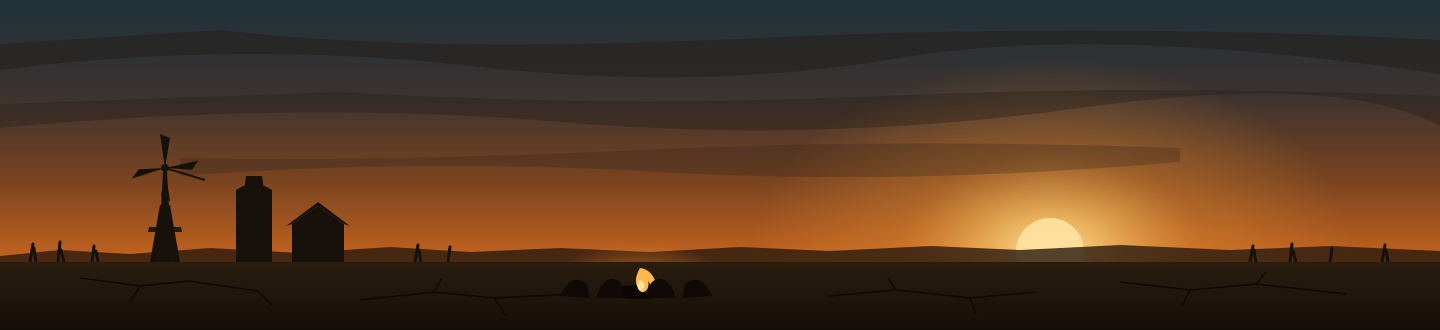
He had not taken the fire in three summers. When he stood up, the valley got quiet a beat faster than it does for Grandmother, which I will never tell her. He held his coffee the whole time and never once drank it, and Mom watched the coffee instead of him, the way you watch a gauge. He talks slower than Grandmother, with real stops, and I have kept the stops, because they were part of the telling.
You all know me as the man who fixes things. Tonight I want to tell you about the years when nothing was broken.
I was a boy in Buras with a library card and a television, and I want to start with the library card, because my father never got over it. He was a citrus man to the marrow, you've heard his wife tell it, and he had a settled opinion that a boy who read indoors in growing season was a boy the family had somehow misplaced. But my mother had a settled opinion too, and hers had a card attached, and the bookmobile came down Highway 23 every second Thursday, and I read every machine book that little rolling parish owned. Pumps. Engines. A children's encyclopedia of bridges I checked out eleven times, which I know because the card was stamped, and stamps were how a boy kept score.
Then one October night the television showed a room in California where grown people were weeping over a picture of rocks. Red rocks, under a butterscotch sky, sent back across two hundred million miles by a machine the size of a golf cart that had landed itself, landed itself, with a crane made of rockets, a thing so past believing that the engineers who built it had a name for the landing that I still think is the most honest phrase my century produced. Seven minutes of terror. And then the picture came, and the room came apart with joy, and I sat on our floor in Buras with the fans going and thought: whatever that room is, I am going to get inside it.
My father looked at the same television and said, "Somebody paid for that." He wasn't wrong either. Hold onto his sentence. It comes back.
I didn't get that exact room. I got the next best thing, by way of scholarships and a bus ticket and being the first Ancelet anybody could name who left the parish for something other than a war. An engineering degree, and then a lab in the Midwest where we taught machines to see. That was my whole job, if you want it in one word. Sight. A camera on a boom, a tractor underneath it, and the long stubborn work of teaching forty thousand pounds of iron the difference between a corn seedling and a pigweed at twelve miles an hour, in changing light, in dust, forever, without once being wrong in a way that cost a farmer his row.
I loved it the way you people love weather. Completely, and with no vote in the matter.
The first time one of my machines drove a quarter mile and touched nothing it wasn't supposed to touch, I called my mother at ten o'clock at night, and she listened to me go on, and then she said, "Emile, you sound like your father the year the whole grove set fruit." Which is the nicest thing anyone has ever said to me, and she knew it, and that's why she said it.
Now the boom itself.
[He stopped here a while, looking at the fire. Nobody hurried him.]
You have to understand what those years felt like from inside, because from outside (from here, from after) it looks like a fever, and it was, but no one has ever once felt their own fever as a fever. It feels like being finally, gloriously warm.
The money came down like weather. I don't have a better figure for it. Nobody asked what anything cost, because the answer to what everything cost was the same: less than it'll be worth. We hired everyone. We. I still say we, eleven years after the we stopped existing; enter that too. I sat on interview panels for people whose specialties I could not pronounce. My little agricultural lab (lettuce, corn, the seeing of weeds) doubled its budget twice in one year, and not because the world had grown twice as interested in lettuce. The thinking machines were writing and drawing and answering by then, and the money that fed them splashed on everything nearby, and we were nearby.
The demos stopped being demos and started being magic shows. I stood in a field in Iowa (June of '27, I can smell it) and watched one of ours thin an acre of lettuce with a touch a surgeon would envy, and the investors clapped in their good boots, and a man from the money side opened champagne in a machine shed, which if you know machine sheds is a kind of blasphemy, and I clapped too. I want that entered honestly, Del. I clapped too. The machine was beautiful. The field was perfect. Ruthie Okafor (she ran our systems side, you'll hear her name again in this valley's stories if I have anything to say about it) Ruthie leaned over in the clapping and said, "You notice nobody ever asks what happens if we go away?" And I said, "Why would we go away?" And she looked at me the way you look at a good dog, and clapped, and that was the whole conversation, in '27, in Iowa, in the warm.
I'll stay a minute with Ruthie, since I've said her name.
Systems, at that company, meant everything that had to be true before my part got to be impressive: the build racks and the update pipes, and the test bench where a machine lived a whole season in an afternoon, over and over, until the afternoon came out right. Nobody clapped for any of it. There was nothing to watch.
She worked nights by preference. Go back for a forgotten coat at midnight and the one light burning in the building would be hers: glasses up in her hair, shoes somewhere under the desk, two screens and a legal pad. She kept a jar of peppermints on the desk for whoever's night was going badly, and you did not reach for one lightly. If she called you over, it was never for a thing that had broken. It was for a thing that was working and couldn't tell her why. I watched her give three nights once to a fault that had shown itself for a quarter of a second, one time, on one bench. The money side called it fixed, because it had stopped. She called it loose, because nobody could say why it started.
And in a company with a budget line for everything, she asked the questions nobody had budgeted for. What the screen should say to a man wearing wet gloves. Why the manual assumed daylight.
[Theo, from the dark: "Was she the boss of you?"]
Not on the chart. But I never argued with her twice, and I'd like the difference entered.
Here is the part I didn't see, and I was standing in the middle of it, holding a wrench.
Every machine we shipped phoned home. Every furrow it learned, every map it made, every acre of hard-won seeing went up to the company's sky, and none of it came back down as anything a farmer could hold. We sold sight, but we kept the eyes. A man would buy our tractor with his own money (real money, harvest money) and then rent, forever, the right to have it work.
There was a meeting where the forever part went in, and I want you to have the room before I tell you what I did in it.
Upstairs in the newest building, glass where the walls should be, carpet you could lose a bolt in. More money people than machine people, and the machine people sat where the outlets were. Legal came too, two of them, by the door, and nobody had told us legal was coming, which should have been the tell. The meeting ran forty minutes. I have sat longer over a flat tire.
On the screen was a curve. It started at the floor on the left and climbed to the right, and it did not level off at the edge of the slide, and the man presenting pointed that out, as a joke, and the joke did well. He was a decent man; I knew his kids' names. Every machine we would ever ship was under that curve somewhere, and every farmer under the machines, and none of that was on the slide.
The room was warm with agreement.
[He stopped here. He opened his right hand and looked at it, and closed it again.]
I sat in the meeting where the locks went in. I raised my hand (I'll give myself that much, one hand, once) and I said something about the man who owns the iron owning the fix, and a person whose job was money explained, kindly, to a person whose job was seeing, that recurring revenue was the future of the industry and that our customers valued a seamless experience. Seamless. Write that word down too, Del, next to resilient. Their whole language was words for eggs you can't open.
And I put my hand down. The demo was in an hour. The machine was beautiful. The field was waiting. That's how it happens, children: not with a villain, with a schedule.
Meanwhile the weather of money was becoming actual weather. The thinking machines ate power the way the Gulf eats coastline (patiently, totally) and the buildings that fed them went up wherever land was cheap and grids were generous, whole counties' worth of electricity going into windowless boxes that hummed. I toured one once, a supplier trip. Cold as a church and loud as a falls, and our guide said, with real reverence, that the building used more power than the city I'd just driven through, and everyone on the tour nodded like that was a specification and not a confession.
They had taken our phones at the door, and they gave them back at the end, and the guide apologized for it the way you apologize for a rule you're proud of. Then they walked us out the long way, past the racks, which were the part the tour was proudest of. Rows of them breathing that refrigerated wind, small lights by the thousand going about their business. You could not see one thing being made. That's not a complaint; you can't see sight being made either. But I had stood in fields my whole working life, and my hands kept looking for the crop.
Outside, the heat was waiting where we'd left it. The lot was new asphalt, striped for three times the cars that would ever come. Off the north corner sat the substation, new steel behind new fence, lines coming in heavy from two directions. And past the boundary fence, ten feet past it, corn stood tassel-high right up against the wire, somebody farming at full volume against the outside wall of all that hum.
A man from our power side rode next to me in the van after. He had asked the guide two questions all day, both about cooling water, and neither answer came with a number a man could write down. Going back he said nothing at all. He watched the corn out the window until the corn was gone, and I didn't ask him for his total.
And the sky, those same two years, was doing something none of our models had a file for. The super El Niño of ’26, the first one, the one nobody alive had seen the like of: the Pacific ran a fever past every record on the books while we clinked champagne in machine sheds, and the maps our machines saw the world through started needing corrections weekly, then daily. We shipped updates. That was the whole answer, updates, and I want you to hear how confident we said that word.
The corrections had a desk by then, in the corner of the lab; then the desk had a second chair; then the corner had a door. A correction, so you know the size of the word: a place where the model's picture of a field and the field itself had come apart, wide enough to cost somebody money. The queue behind that door never emptied. You could work it down to nothing by dark and it would be full again by morning, fed in from growers we never met, out of weather the maps kept being wrong about. We had named the versions after towns once; we started naming them after the month, and then the month wasn't narrow enough. Two of the corrections in that queue were mine. I'll say that plainly: mine, signed, shipped. The model had my hands in it too.
There was a man on our crop side, twenty-some years of fields in him, who started keeping his own notes on paper about then. A composition book, rubber-banded shut, riding on his dash. Nobody asked him to do it, and after a while nobody mentioned it. In pencil, after we had shipped what the model said a field would do, he wrote down what the field did. He kept it in the truck, not the lab.
The weather had come off its own training data, and our fix was to patch the eyes and bill the farmer, and it worked just well enough, just long enough, that nobody upstairs asked what happens when the patching stops.
My father called me that spring (this is '28 now, the top of the fever) because the parish had been offered a data campus of its own, tax-abated, down where the Herberts' grove used to be, and he wanted to know what I thought, me being inside the room and all. And I gave him the room's answer. Jobs, I said. Investment. The future of the industry.
He was calling from the kitchen phone, the corded one; he never did hold with carrying a telephone on his body. I heard the chair take him when he sat down with it: he sat down to telephone, my father. It was evening down there. Behind his voice the parish was at its supper hour, a boat working home somewhere down the pass, a marine forecast going low on a radio. Under it all, the Gulf, which you stop hearing while you live there and never stop hearing after you leave.
And I knew the ground the offer stood on. I had picked in the Herberts' rows for pocket money. Miss Odile Herbert paid a boy in coins and cane syrup, and she looked at your bootlaces before she looked at you. Rows straight enough to sight down like a barrel, and the Gulf right there past the levee the whole time. A storm took the trees and the salt took the stumps, and the land had sat quiet ever since.
[He stopped here, the longest of the stops. Down the draw a whip-poor-will started up, and he let it finish.]
And my father, who never left Plaquemines Parish and never needed to, was quiet a second on the line, and then he said the sentence again, the one from the rocks on television, twenty years on:
"Somebody's going to pay for that."
He didn't live to collect on being right. I count that a mercy, most days.
Why am I telling you all this tonight, when I've kept it three summers? Because a man stood in the Grange last week and showed this valley the golden hour (the campus low and planted, the numbers rising gently off the ridge like fireflies) and I sat in the back and watched your faces, every one of you, and I recognized every one of them. That was my face. In Iowa. Clapping.
So hear the whole of it from the one person here who was inside the warm. The dream is real. Machines that see. Grids that think. Rooms in California crying over rocks. Real, and worth wanting; I will not stand at this fire and tell you otherwise, because you'd smell the lie on me, and because the boneyard behind my shed runs on the true parts of that dream every single day.
What I've learned, the expensive way, is one question, and it's the only souvenir I kept from the boom besides a cable. Ask who keeps the eyes. Ask it about every beautiful thing anyone ever drives up this valley to sell you. Everything else about the boom was wonderful.
Next fire, if you'll have me, I'll tell you how it ended. Somebody should, and I was there, and it fits in a Tuesday.
He sat down and finally drank the coffee, which was cold, and did not seem to notice, and Mom took the cup out of his hand the way you take a tool from a man who's finished with a job. I wrote in the margin: ask who keeps the eyes, and underlined it twice, and then, because the book should hold the other one too: somebody's going to pay for that. D.A.