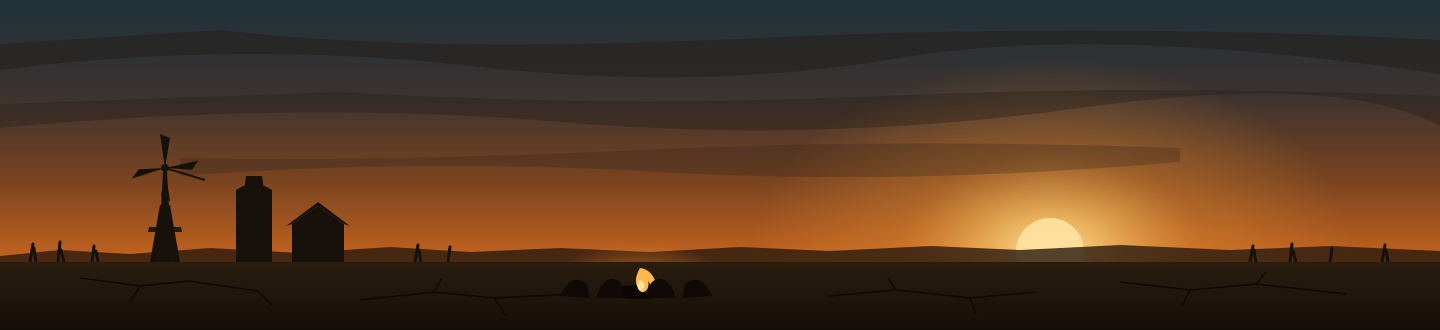
Sit down, all of you. Theo, come off that fence; you will tell your own children you heard this sitting still. Good. Now.
I was born in Plaquemines Parish, Louisiana, sixty-seven miles of river below New Orleans, in a house my grandfather built on ground his grandfather drained. You have to understand what that ground was. It was marsh once (rice and cane, back before anybody living could remember) and the men in my family took the water out of it one ditch at a time so that oranges could go in. That is what we were. Not just farmers. Citrus. Louisiana sweets and satsumas, the sweetest fruit grown in this country, and I will fight the man who says otherwise, because the university people tested it once and the science came out on my side. Thin rind. Sugar all the way through. And do you know why? The dirt. River silt, come down from Minnesota (hear me, from Minnesota, from right up past where we are sitting tonight) down through every bend of that river, two thousand miles of the richest ground on this continent, and it all settled out at the bottom end for us to grow candy in.
My father had five thousand trees. When I was a girl you could drive the highway south toward Venice and it was grove after grove after grove, all the way down to where the road gave up, and in March the whole parish smelled of blossom so sweet it would give you a headache you were grateful for. We sold fruit off tables by the road. We hauled it up to the city in crates with our name stenciled on the side. The river ran on one hand of us and the Gulf lay on the other, and between them was a strip of made ground about as wide as a promise, and we lived on it like kings who did not know they were renting.
The tide was our clock. Delphine will tell you; she was raised to it before she was raised to anything else. The water had a schedule, and the schedule ordered the day: when the shrimp boats went, when the locks worked, when you could get down to the low groves dry-shod. I could tell you the hour by the smell of the marsh. That is not a boast. That is only what it is to belong to a place with your whole body.
Now.
Now I want you to understand that it did not happen all at once. That is the lie they tell about us, the ones who write it down after: that a storm came, and the sea ate the coast, and we ran. No. It was slow. It was so slow you could farm right through it and tell yourself each year was only a bad year. The land was sinking. It always sank (that is delta; delta sinks) but the river had been walled off up north for a hundred years so it could not lay down new mud to feed us, and the Gulf was coming up to meet the sinking, and the two of them closed on us like a hand closing. A little every year. A football field of Louisiana gone every hour, they used to say on the radio, and you did not see the hour. What you saw was that the back forty was wet where your father kept it dry. That the salt had gotten the low trees. That the next storm reached one road further up than the last one, and the road it reached was yours.
The storms have names, and I will say them, because you do not let the things that beat you go nameless.
Katrina came when your father was a boy. Twelve years old. Half our trees drowned or broke in one night, and the salt water stood in the groves for weeks, and my father, your great-grandfather, walked the rows in his rubber boots saying all right, over and over, all right, all right, which in our family is a complete sentence meaning we will now do the enormous thing. We replanted. That is what citrus people do. A tree is a twenty-year promise, and you do not walk out on a promise because of one bad night. Emile grafted his first rootstock that spring, ten fingers and a pocketknife, and ruined forty of them before he made one take, and the one that took outlived the man who taught him.
Then the freezes, which nobody expects when they hear our story, but a satsuma can bear more cold than people think, and less than it needs to up here, which is a different night’s arithmetic.
I will tell you what a freeze night was, because up here the cold comes in November and stays, and down there it came like a thief: one night, maybe two, in behind a front, with the stars sharp as tacks. The radio read out the number at supper, and the number was the whole conversation at the table. A freeze that comes with wind you cannot fight; you shut the house and take what the morning gives you. A freeze that comes still, you can fight, because still cold settles the way water settles, into the low rows along the back ditch, and a man who knows his ground knows where it will pool before it pools.
There was a night, the first winter I was tall enough to be useful, when the wind lay down at dusk, and my father walked the headland with his hands behind his back, choosing, and I walked behind him with the lantern. My job was to hold the light where he was looking and to keep my mouth closed, and I did half of it. He chose out loud, row by row, quiet, like a man counting money he did not have: the young blocks first, because a young tree dies whole; then the best of the bearing rows, as far as the oil would go; and the rest he gave to the night. You did not stand there being sorry about it; there was oil to haul.
So we hauled it, and we fired the pots. Smudge pots, children: squat iron stoves set down the middles of the rows, filled by hand, lit by hand, tended by everyone in the family old enough to be trusted near oil, in coats that smelled of it till Easter. From the porch the grove looked like a town seen from across water, a hundred little fires minding their own business. One short year we burned windfall limbs and fence posts and broke-up crates in open piles between the rows, and nobody said anything over them. And where the pots gave out, we ran the water, and nobody believes the water until they have stood in it. You set the sprinklers going and you let the trees ice over, and you keep the water coming so the ice never finishes freezing, because water gives up its little bit of heat in the act of turning, hear me: the ice is the blanket. By sun-up the defended rows stood in glass.
And then you waited. You knocked the ice at midmorning and cut a sliver of bark with your thumbnail, looking for green under the gray, and my mother put coffee into the hands that had fought, and my father said the same thing every time, which is the true thing about trees, and I have not forgiven it: that we would know in June.
June.
Then Ida. Ida came the year you were born, Delphine. We hauled the generator to the barn and your mother nursed you through the whole of it with the roof working like a lung, and in the morning the grove was on its knees and the salt was in the groundwater, in the wells, and the seedlings my brother had babied three years went yellow and crisp inside a week.
That night, Delphine, from the inside, since you were in it and cannot testify: the generator ran the pump and one bulb, and the bulb swung, and the shadows of everything in that barn swung with it. Your grandfather and Emile took turns leaning on the door when the gusts came around trying it, and they did not discuss the schedule; it changed hands on its own. Your mother sat on a hay bale with you inside her coat, and she had her shoes on. All night. Both shoes, tied. I have never told her what that told me. Things went over the roof in the dark that we could not name in the night and never found in the morning, and underneath everything the pump kept on, small and steady, and I listened to the pump instead of the roof until daylight.
The morning after a storm like that has a smell, salt and diesel and bruised leaf; I would know it blindfolded. We went out into it counting. And my brother came at midday, from his place down the road, to look at his seedling rows. Three years he had raised those trees by hand: bucket-watered through two dry springs, staked, banked at every cold snap, and talked to, I have no doubt, because the men of this family talk to whatever they are raising. He walked the first row slow, and the second row slower. At the third he knelt and pulled one seedling up whole, and it came up too easily. He held it a while, looking down the row he was kneeling in. Then he laid it back where it had grown, and pressed the dirt over the roots with the flat of his hand, and stood, and wiped his hands on his thighs, one and then the other, like a man leaving a table. And that is all I will be telling about my brother.
We replanted what we could. We were fewer replanting every time. You would look down a row and see the gaps, and the gaps were not only trees.
And here I must tell you about the Island people, because they were the first, and we owed them better than we paid.
Isle de Jean Charles. Terrebonne. A strip of ground out in the marsh with one road to it that drowned at high water, and families on it who had been there longer than the state of Louisiana had been a state. When I was young that island was already going, it lost all but a sliver of itself in my lifetime, and the government, back when there was the kind of government that did such things, paid to move the whole community up to higher ground. The first ones. The first town in America moved for the water, and we read about it at our kitchen tables sixty miles away and said poor them, and went back to our coffee, as if the water knew a fence line. As if it would take the Island and then be satisfied. I think of those families every time somebody up here says the word haven. There is no haven. There is only higher ground and what you do on it.
But here is the thing that finally took us, and I want the young ones to hear it, because it was not the water. We could fight water. My whole family history is fighting water. It was the paper.
The insurance went first. You children laugh when the old people talk about insurance, because to you it is like hearing we kept a dragon, but understand, it was the floor under everything. And one year the floor was simply gone. Not dear. Gone. No company in the state would write a policy on a citrus farm sixty-seven miles down a sinking parish, and the state’s own last-chance outfit wanted more for one year of cover than the farm cleared in two. And a farm you cannot insure is a farm the bank will not lend on, and a farm the bank will not touch is worth, on paper, nothing. Overnight. Ground my family made with their hands out of a swamp: worth nothing, not because it had washed away, but because a man in an office had finally stopped pretending it wasn’t going to.
I was in the kitchen for the afternoon itself. The letter came with the ordinary mail, and that is the part I want you to hear. The end of a farm does not come up the road with lights turning. It comes folded in thirds, under a seed catalog, and it waits its turn while you eat your dinner.
Your grandfather had seen the envelope when he carried the mail in. He set it by his plate and ate first, and I have wondered since whether he knew, and I never asked him. Then he read it standing up at the window, and then he pulled his chair out and sat down and read it again, and I had never in my life seen that man read a piece of paper twice. It was one page. They regretted. There was a number to call, and he never called it.
He laid the page in the middle of the table and set his coffee cup down on it, square, the way you weight paper against a wind, and there was no wind in my kitchen. We looked at the cup a while, the two of us. Then he said: The trees don’t know it yet, Trèse. And he took his hat off the nail and went down and pruned deadwood until it was too dark to see the cuts, and I let him. The cup stayed on that letter until morning. Neither one of us would move it.
And that week you could all but follow the letter up the road, box by box, the same envelope, the same fold. Nobody telephoned anybody; there was nothing to trade, because every kitchen had the same page and the sums came out the same. At the feed store men stood with their hands in their pockets and priced nothing out loud. By the end of that month the parish had learned to say a whole thing with no words in it, at the diesel pump, at the church door: a nod, going both ways, that meant you too. And after that came the sale bills on the light poles, good equipment, no crowd.
The water took the Island people’s land an acre at a time. The paper took ours in an afternoon.
Then the Crash, in ’29, which reached down the river from the money world and took whatever the paper had missed, but that is your father’s story, and he tells it better than I do, because it made him angrier than it made me, and anger is good for the details. And the sick year after that, the year we could not even gather (no fires, no funerals worth the name) which is Renata’s story, and she has earned the telling of it. I keep to my subject. My subject is oranges.
The last springs, the river turned on us. You have heard me say the river ran on one hand of us all my life like a big slow dog. Well: the drought years came, the hot years, and the river up north fell so low that the Gulf walked up it. Salt, crawling along the bottom of the Mississippi like something hunting, a mile and more a day. They pushed a wall of mud across the riverbed to stop it reaching the city’s drinking water, and the salt topped it, and they raised it, and the salt waited, and meanwhile down our way they were barging fresh water to the taps. Barged water. To people living on the bank of the greatest river on this continent. Months of it. I stood in my own grove that last October and watered my grandfather’s trees out of a plastic tank that had come down on a boat from somewhere else, and that (not the storms, cher, not even the paper) that is the day the ground told me it was done being ground.
The choosing, then. Between the ground quitting and the road there is a week nobody tells about, when you walk your own house like a stranger with a measuring eye. The truck was one truck. The house was full to the rafters with us. Somebody had to be the judge, and I was the judge; not because I was the hardest, but because I had already done my crying, in October, standing up, with a hose in my hand.
The grafting knife went first, into the glovebox, before one stick of furniture was decided. The good ladder rode on top, the cypress one, tied twice. Budwood went wrapped in damp cloth, in a crate for the cab, where I could keep my hand on it. And the stencil plate came off the packing line, pried loose with a claw hammer, our name cut through it in letters you could read with your fingers, and went in wrapped in a feed sack.
Emile made the case for the anvil. I said no to the anvil. In the morning the anvil was in the truck anyway, under a quilt, like I would not notice an anvil, and I stood at the tailgate until it came back out. He had his trailers for the dead iron; the cab was mine. You may ask him tonight whether he has forgiven me. He is sitting right there.
Your mother packed one box of papers, births and deeds and school records, tied with string, and set it under the seat where her feet could find it. Every yard on that road was holding the same court that month; you would drive past a family standing in the grass around a piano, and you did not slow down, out of respect. And the rest stayed where it stood, and I will not stand at this fire reading you the list of it: it did not fit, and we did.
We raised who we could from the churchyard. I will say this part once and you will not ask me questions after. The water had been in the cemetery twice that year, and the parish had a program, and there are people whose whole work in this world had become the moving of the dead ahead of the sea. Your grandfather Alcide we left where he lay, up on the high shell ridge by St. Thomas, because he had told me plain, before he went: Trèse, a man should stay where his trees can find him. So he stayed. You can carry a tin, children. You cannot carry a churchyard. When people up here ask me what we lost, they are counting acres. They have never once counted right.
The last tree. All right. The last tree.
We had one satsuma still bearing at the end. One, out of my father’s five thousand. Down by the old pump house, on the highest hummock we had, which was maybe four feet above where four feet still meant something: older than me, that tree, grafted by a hand I never knew. And that last October, with the grove gone to salt flats shining around it and the packing shed already sold for the tin on its roof, that tree put out nine fruit.
Nine.
I picked them myself. I would not let Emile up the ladder, I would not let anybody: a woman is allowed one ceremony she does not explain. And we ate eight of them standing right there in the ruin, the whole family in a circle, your mother holding you on her hip, Delphine, and you with segment juice down your chin like a queen at her coronation, and Theo not yet dreamed of. And it was, I will say it plainly, the best thing I have tasted in this life, and I have never eaten one since without I have to stop a minute first.
The ninth one I did not eat. I dried it, the old way, whole. It is in the tin, in my room, and some of you have seen it: that small hard black thing that does not look like anything at all. That is the last orange in Buras. That is my father’s five thousand trees and his father’s ditches and the smell of March in Plaquemines Parish, all of it, dried down to a fist you could close one hand around. I brought it up this river twelve hundred miles, past every toll and every checkpoint, and not one of the men at the crossings thought it was worth declaring. They were wrong. It was the only cargo on that truck.
The road itself (the caravan, and what the road was like in ’35, and the night at the Cairo bridge) that is a story for another fire, and Delphine has it half in her book already, so it will keep.
I will tell you instead how this story ends, because it ends uphill. It ends the third spring here, when your father and I put the first satsuma graft into this Wisconsin hillside: into ground that used to freeze too hard for anything but hate to grow, and does not freeze so hard anymore, which is the one bitter gift in all of this and I have decided to take it. People ask me why. Why oranges, in a place that is supposed to laugh at oranges. And I will tell you what I was thinking with my thumb on that first bud, and it was not revenge, though the good Lord knows I have the material.
I was thinking: the silt came all the way down from Minnesota, once, to make us. Two thousand miles of this river carried the north down to Louisiana and built the ground my people stood on. Well. The ground cannot come to us anymore. So we have come up to meet it. We have gone to the dirt, since the dirt could not come to us, and if the river will not carry the makings south again, then it can watch us carry them north, one family, one tin, one graft at a time.
That is why we grow oranges on this hill. Not to prove we can. To prove we are still us: that they moved this family a thousand miles, and took the ground out from under four generations, and salted the graves of our dead, and we are, tonight, right now, still the people who grow the sweetest fruit in America. Only farther north than anybody has ever done it.
Pass the bowl. One each. One, Theo: I count faster than you eat.
And did you hold still the whole way through? You did. Good boy. Now you know the start. Everything after this is just us, not giving up.